

Nice one! You're interested in finding out more about our great products! Have a read and then afterwards why not wander over to the shop at the wall you're in and grab some GEKCO!

GEKCO’S
ENVIRONMENTAL PILLARS

-

Carbon negative
125% carbon negative as an absolute minimum. Our carbon emission figures take into account every possible source we can uncover carbon emission date for within our supply chain and business. We don't solely look at what we directly produce, but also that of our suppliers. In technical terms this means we also look at scope 3 and not just scope 1 & 2.
-

Sustainable sourcing
We choose to use seawater processed chalk which is currently the most environmentally-friendly sourcing option. Our packaging is sourced from recycled material where possible and is fully kerbside recyclable, alongside schemes to reduce waste such as our Bulk Refill Scheme and Bottle Return Scheme.
-
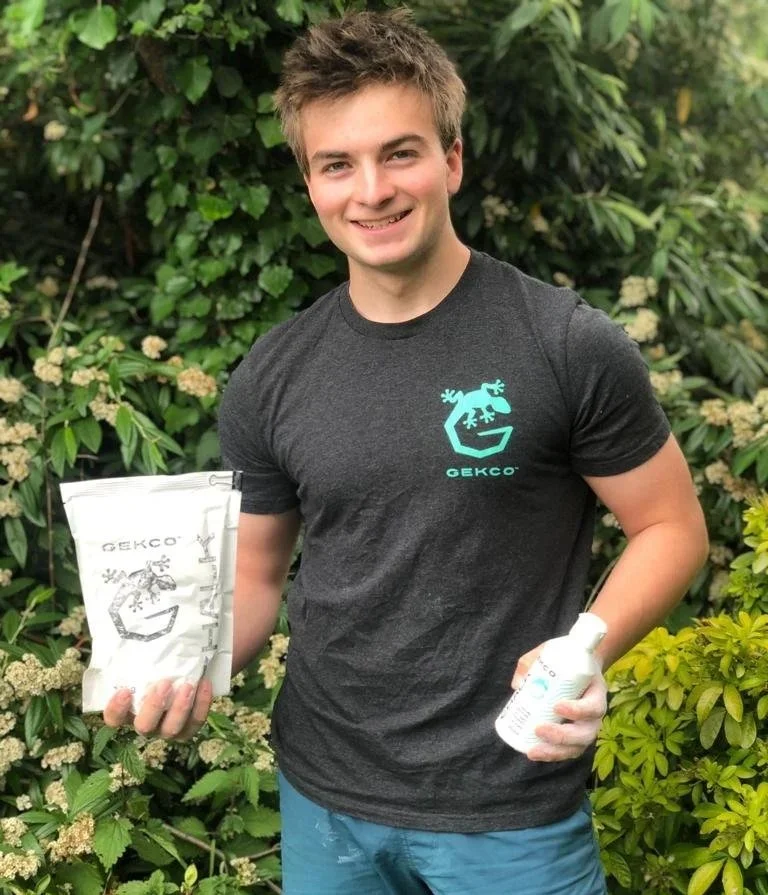
community initiatives
Operate a self-tax scheme to support charities and organisations such as CAC and Mountain Rescue, as well as nationwide initiatives like crag cleanups and maintenance. We also support young athletes with their professional climbing careers through our athlete program. It is key that we reinvest into our communities.
-

Research and development
Our goal is to constantly produce and innovate towards the most environmentally-friendly products possible, without compromising performance. We’re working tirelessly on zero/low waste versions of our current and future products in order to make change across the climbing and outdoor industry.

MORE DETAILS ABOUT
Our chalk sourcing
GEKCO chooses to source raw materials for our chalk production from seawater processing. Compared with the most common source of mined materials from China, where mining operations have caused severe degradation to the environment, personal health of workers and living conditions of nearby towns.
The benefits of seawater processing are:
Full or partial use of solar energy during manufacturing
Limited land scarring and environmental degradation
Regulated higher standards for workers
Production is controlled in line with environmental policies with tighter waste management and airborne particulate controls
Based wholly on research, our findings suggest this to be a more sustainable and environmentally friendly method. However we will always strive to find the most sustainable options available and with a constant R&D effort, we are able to monitor changes in the market and identify any new and potentially alternative solutions and sourcing methods that offer an improvement to the sustainability of our product.
MORE DETAILS ABOUT
Our carbon offsetting
At the end of 2021, we calculated our Scope 1, 2 and 3 carbon emissions as accurately as available data allowed. We then offset over 230% of our carbon through offsetting projects verified by carbon standards.
SOLAR COOKERS FOR REFUGEES IN CHAD
Over 200,000 Sudanese refugees have fled to Chad, sometimes staying in camps for more than 15 years. Finding firewood for cooking is one of numerous challenges facing these refugees, as firewood is scarce in this region. Women and children are forced to travel long distances to collect firewood, while facing harassment, assault and abduction. In order to tackle this issue, CooKit was launched in 2005, a cooking stove that uses solar energy, which is plentiful in Chad. This project is Gold Standard verified.
Benefits of CooKit Project:
Prevention of carbon emissions through a huge reduction in wood fires
Improvement to safety of women and children especially
Increased school attendance of children
Smokeless cooking has improved the health of refugees
Reduction of wood fires has slowed the rate of deforestation by more than 50%, ensuring carbon remains within the biomass and continued absorption of carbon
UK FOREST CREATION AND PEATLAND RESTORATION
These are Woodland Carbon Code verified projects provided by Forest Carbon of which our purchase contributes to three forest creation projects and one peatland restoration across England and Scotland.
Not only will woodlands sequester and store carbon, they also foster habitats, support biodiversity and provide natural flood prevention. Peatlands are critical in mitigating climate change and also provide natural flood protection and support biodiversity.
These credits are different and are known as ‘ex-ante’, as they invest in future carbon reductions as trees take years to reach full maturity. It was important to us to invest in the future of the UK, replacing woodland that has historically been chopped down. These cannot immediately be claimed as offset credits, but will become so in the future.